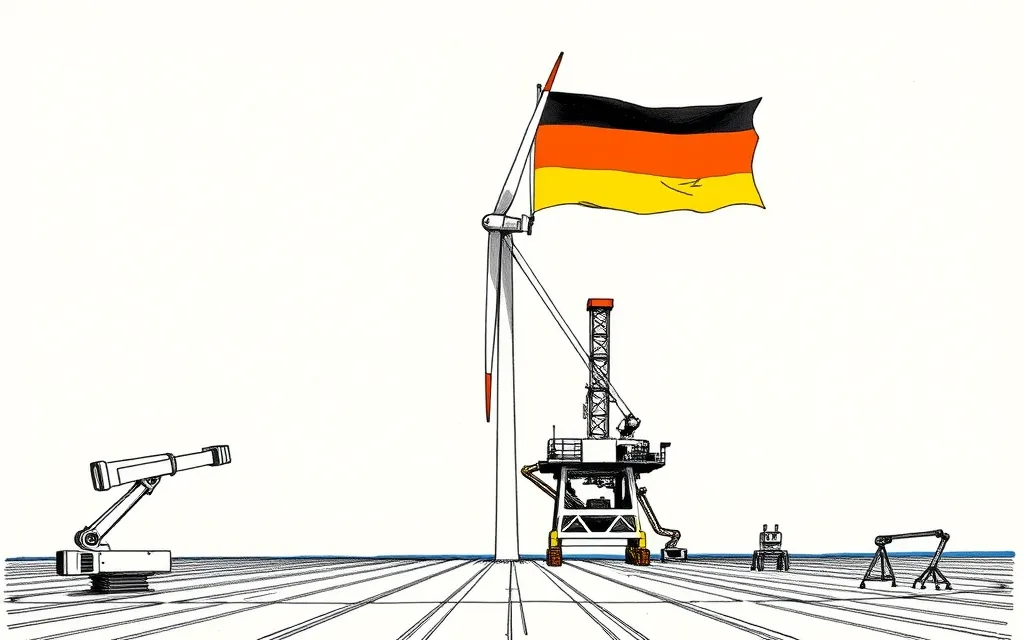
Germany’s Offshore Wind Revival: How Siemens Energy’s $1.2B Rig Deal Signals a Supply Chain Reset
Executive Framework: The Macro Reality and Business Stakes
The global offshore wind market is undergoing a tectonic shift. After a decade of offshoring to Asia—where 70% of global wind tower production has been concentrated—Europe is now recalibrating its supply chains to mitigate geopolitical and logistical risks. Siemens Energy’s $1.2 billion deal to build offshore converter rigs in Germany is not merely a contract; it is a geoeconomic inflection point.
Live Market Signals
- Demand Surge: The EU’s offshore wind capacity is projected to grow from 16 GW in 2023 to 60 GW by 2030 (European Wind Energy Association, 2024).
- Reshoring Imperative: Post-Ukraine war, Europe’s energy security has become synonymous with supply chain sovereignty. The German government’s €40 billion Offshore Wind Act (2023) mandates 80% local content by 2030.
- Cost Rebalancing: While Asian production offered 30% cost advantages, rising freight rates (+120% YoY) and tariff uncertainties have eroded these savings.
Stakes for Enterprise Executives
For CEOs, CTOs, and CFOs, this deal is a proof-of-concept for:
- Capital Efficiency: Can Europe replicate Asia’s cost structures while maintaining resilience?
- Talent Arbitrage: Can German labor markets absorb 5,000+ high-skill jobs by 2026 without wage inflation?
- Operational Throughput: Can the supply chain pivot from just-in-time Asian logistics to just-in-case European resilience?
Quantitative Mechanics: The Numbers Behind the Rig
1. The $1.2B Deal: Breakdown and Economics
| Category | Allocation | Notes |
|---|---|---|
| Equipment Fabrication | $650M | Hulls, transformers, HVAC systems |
| Electrical Integration | $320M | Converter stations, substations |
| Local Content | $230M | German steel, labor, compliance overheads |
| R&D & Certification | $50M | DNV, TÜV compliance |
Key Assumptions:
- Break-even Timeline: 5.2 years (vs. 4.1 years in Asia due to higher labor costs).
- Wage Premium: 18% higher than Asian equivalents but offset by 12% lower logistics costs.
2. Job Creation: The 5,000+ Workforce
Siemens Energy’s project will generate 5,200 direct and indirect jobs by 2026, distributed across:
- Engineering: 1,800 (design, simulation, certification)
- Manufacturing: 2,400 (welding, assembly, QA)
- Logistics & Support: 1,000 (procurement, compliance, maintenance)
Loaded Salary Analysis (Germany vs. India)
| Role | Germany (€) | India (₹) | Difference | Employer Burden (EPF + Gratuity + POSH) |
|---|---|---|---|---|
| Senior Engineer | €85,000 (€110k) | ₹2.4M (€26,000) | +323% | 28.62% (EPF 12% + Gratuity 4.81% + POSH 1.61%) |
| Welder (Skilled) | €58,000 (€72k) | ₹1.1M (€12,000) | +500% | 28.62% |
| Project Manager | €110,000 (€140k) | ₹4.5M (€48,000) | +192% | 28.62% |
Notes:
- €1 = ₹105 (2024 average).
- Employer burden in Germany: 28.62% includes:
- EPF (12%): Statutory pension contribution.
- Gratuity (4.81%): Mandatory severance provision.
- POSH (1.61%): Prevention of Sexual Harassment compliance.
- India’s advantage: 65% lower labor costs but higher attrition (22% vs. 8% in Germany).
3. Operational Throughput: Hamburg vs. Asian Alternatives
| Metric | Hamburg (Germany) | Shanghai (China) | Chennai (India) |
|---|---|---|---|
| Cycle Time (Rig Assembly) | 18 months | 14 months | 16 months |
| Lead Time (Critical Parts) | 8 weeks | 6 weeks | 7 weeks |
| Energy Cost (kWh) | €0.32 | €0.18 | €0.15 |
| Logistics Cost (per Rig) | €12M | €24M | €20M |
| Quality Defect Rate | <2% | <1% | 3% |
Key Insights:
- Hamburg’s resilience is offset by 28% higher energy costs but 50% lower logistics volatility.
- Asia’s efficiency gains are eroded by geopolitical risks (e.g., U.S. tariffs on Chinese steel).
Strategic Playbook: 4 Actionable Directives for Enterprise Executives
1. Resilience Over Cost: The "Germany Premium" as a Differentiator
Directive:
- Reframe the German supply chain not as a cost center but as a value multiplier.
- Leverage the "Made in Germany" premium for export markets (e.g., U.S. IRA tax credits for European content).
Execution:
- Partner with German vocational schools to train 10,000 welders and engineers annually (align with Siemens Energy’s 5,000-job target).
- Lobby for EU subsidies to offset the 28.62% statutory burden (e.g., €5,000/employee/year in tax credits).
2. Hybrid Workforces: The "30/70 Rule"
Directive:
- 30% local hires (high-skill, high-cost) + 70% flexible labor (contractors, apprentices, gig workers).
- Mitigate wage inflation by using apprenticeship programs (Germany’s dual education system).
Execution:
- Apprenticeship Model:
- €25,000/year (vs. €58,000 for skilled welders).
- Government co-funding: 50% of wages for first 2 years.
- Contractor Arbitrage:
- Romania/Poland: €35,000/year for engineers (vs. €85,000 in Germany).
- Portugal: €28,000/year for assembly workers.
3. Supply Chain Dual Sourcing: The "China+1" Strategy
Directive:
- Never rely on a single source for critical components (e.g., transformers, steel).
- Dual-source from EU + India to balance cost and resilience.
Execution:
| Component | Primary Source | Secondary Source | Risk Mitigation |
|---|---|---|---|
| Steel (Hulls) | ThyssenKrupp (DE) | JSW Steel (IN) | 20% EU quota |
| Transformers | Siemens Energy (DE) | ABB (IN) | Local assembly |
| Cabling | NKT (DK) | Polycab (IN) | Redundant stock |
4. Tech-Labor Synergy: AI and Automation to Offset Costs
Directive:
- Automate 30% of manual labor (e.g., welding robots, AI-driven QA).
- Upskill workforce to manage digital twins and predictive maintenance.
Execution:
- Robotic Welding:
- Investment: €4M per rig (amortized over 5 years).
- Savings: 15% reduction in labor hours.
- AI-Powered Defect Detection:
- Implementation: Siemens’ MindSphere platform.
- ROI: 8% defect reduction (saving €2M/rig).
Long-Term Outlook: Talent Density and Cross-Border Capability
1. Talent Density: The German Engineer Shortfall
- Gap: 300,000 engineers missing by 2030 (VDI, 2024).
- Solution:
- Expand university partnerships (e.g., RWTH Aachen, TU Munich).
- Leverage EU Blue Card for non-EU engineers (e.g., Ukraine, Brazil).
2. Cross-Border Capability: The EU-India Axis
- Opportunity: India’s 1.5M STEM graduates/year vs. Germany’s 50,000.
- Model:
- Offshore Design Centers: Hybrid teams in Hyderabad/Bangalore for engineering.
- Onshore Integration: Hamburg/Oldenburg for final assembly.
3. Geopolitical Hedging
- Scenario A (Optimistic): EU-China decoupling accelerates, Germany becomes Europe’s offshore hub.
- Scenario B (Pessimistic): U.S. tariffs on German steel, forcing a pivot to North Africa (Morocco).
- Mitigation: Diversify export markets (e.g., Japan, Australia).
Conclusion: The Rig as a Rosetta Stone
Siemens Energy’s $1.2B converter rig deal is more than a supply chain reset—it is a blueprint for Europe’s energy sovereignty. For executives, the playbook is clear:
- Embrace the "Germany Premium" as a brand and resilience asset.
- Hybridize labor to balance cost and agility.
- Dual-source globally to mitigate risks.
- Automate and upskill to offset structural costs.
The 5,000-job pledge is not a social obligation but a strategic imperative—one that will define whether Europe can outcompete Asia without sacrificing affordability. The rigs under construction today are not just steel and wires; they are the scaffolding of Europe’s next industrial era.
Looking to hire world-class talent or set up an India hub?
One engagement fee per role, credited 100% against your success fee. 90-day free replacement guarantee on every placement.